Results
DisParQ is evaluated on seven datasets: ImageNet-1k, Places365, PartImageNet, CUB-200-2011, Stanford Cars, Stanford Dogs, and Oxford Flowers. The authors train one model per dataset without class labels. Unless noted, the main comparison uses frozen DINOv2-B/14 with registers and DisParQ's default budget of 16 selected concepts from a 1,024-concept dictionary. The scores below are from the paper and its appendix.
Accuracy through a discrete bottleneck
Only the discrete concept description reaches DisParQ's decoder. Its output remains close to the frozen backbone on large-scale recognition, measured by a linear probe's top-1 accuracy.
| Dataset | DisParQ | Frozen DINOv2-B/14 | Difference |
|---|---|---|---|
| ImageNet-1k | 83.2% | 83.4% | −0.2 percentage points |
| Places365 | 55.3% | 55.4% | −0.1 percentage points |
On PartImageNet, its linear probe reaches 89.2%, 3.6 percentage points above the strongest self-supervised concept baseline in the reported comparison. The fine-grained test-set probes are 89.4% on CUB, 91.0% on Cars, 87.8% on Dogs, and 99.7% on Flowers. DisParQ leads the compared self-supervised methods on all ten fine-grained table metrics, with a tie on Flowers linear probing.
Consistent, localized parts
On PartImageNet validation images, DisParQ leads self-supervised methods on seven of ten reported downstream, part-quality, and grounding metrics. Its concept consistency is 16.3, compared with 12.4 for the language-grounded CFM dictionary. Its mapped adjusted Rand index is 62.3, compared with 56.3 for the strongest self-supervised baseline on that metric. ProtoQuant's label-free first stage leads on foreground purity and FG-ARI, where DisParQ ranks second.
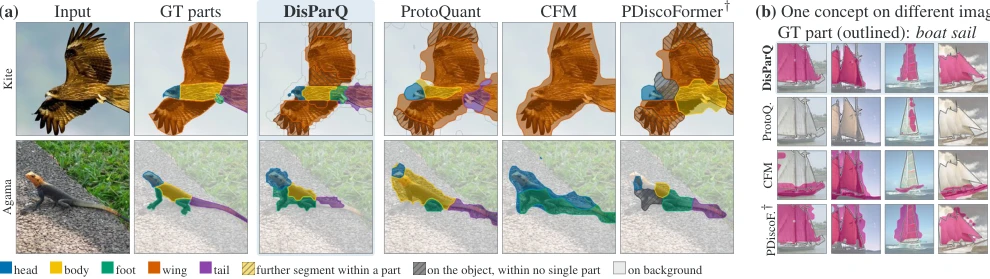
These maps illustrate how exclusive assignments can follow distinct object parts. They are selected examples. The paper's appendix includes additional examples and failures, and the concept explorer provides more images and concept occurrences.
Retrieving a part across categories
The paper introduces a part-to-part retrieval benchmark. An annotated part region is described by the concepts it contains. The task is to retrieve the same part in other images, including images from different categories. On PartImageNet validation, at the 32 × 32 concept grid, DisParQ reaches 79.7% recall at rank 1 and 30.5 mAP. The best self-supervised baseline scores on those metrics are 79.2% and 27.0 mAP, respectively, from different methods. An oracle based only on co-occurrence groups of part labels reaches 43.9% recall at rank 1 on this query set.

The same part-retrieval study reports 36.8% recall at rank 1 for DisParQ with DINOv2-B/14 on CUB keypoint queries. The DINOv2-S/14 configuration reaches 33.6% on that task. Retrieval comparisons should be read within each reported grid and query set: changing the grid changes which part queries are available.
Human evaluation
In a study with 120 participants across CUB, Cars, and PartImageNet, people rated DisParQ's concepts as more consistent than the compared PIP-Net and CFM concepts. When asked to match a concept to one of four regions in a new image, they selected the correct part 69% of the time for DisParQ, versus 60% for PIP-Net and 53% for CFM. Chance is 25%.
More from the appendix
The supplementary experiments test whether the findings persist across backbones, concept budgets, and attribute encoders. They also report the full CUB part metrics and a separate study of adding names to concepts after training.
Across frozen backbones
On PartImageNet, the quantized model was tested in seven configurations of six frozen backbones: DINOv2, DINOv3, CLIP, SigLIP2, TIPSv2, and CLIP-DINOiser. In six of seven configurations, DisParQ's linear probe is within 2 percentage points of the corresponding frozen backbone's own probe. The CLIP-DINOiser configuration is within 3.5 points. DINOv2-B/14 gives the strongest concept quality at the shared 16-of-1,024 budget, leading the other configurations on seven of eight reported concept metrics. The models use backbone-specific feature grids and targets, so boundary-sensitive part metrics are most meaningful within a grid.
How many concepts are useful?
These are single-run, continuous first-stage sweeps on PartImageNet with frozen DINOv2-B/14 and AnyUp, compared with 16 concepts per image from a bank of 1,024. They are design studies, rather than final quantized-model comparisons.
| Change from the 16 / 1,024 reference | Downstream effect | Concept-quality effect |
|---|---|---|
| Select 4 concepts per image | Linear probe +0.50 points | Foreground ARI −14.37 points, part mIoU −15.31 points |
| Select 32 concepts per image | Not reported here | Foreground ARI −1.83 points, part mIoU −2.17 points |
| Expand the bank to 8,192, still selecting 16 | Linear probe +0.41 points | Foreground purity +4.05 points, but consistency −10.47 points and mIoU −2.53 points |
The 32-concept experiment also increases the budget used for equivariance maps. Across the complete 20-setting bank and concept-budget grid, the highest observed foreground purity is 86.60% at 32 / 8,192, while the default 16 / 1,024 has the highest observed consistency, 16.30%. More prototypes can make individual regions purer while fragmenting a concept's meaning across images. Small differences in these single runs are descriptive, not significance claims.
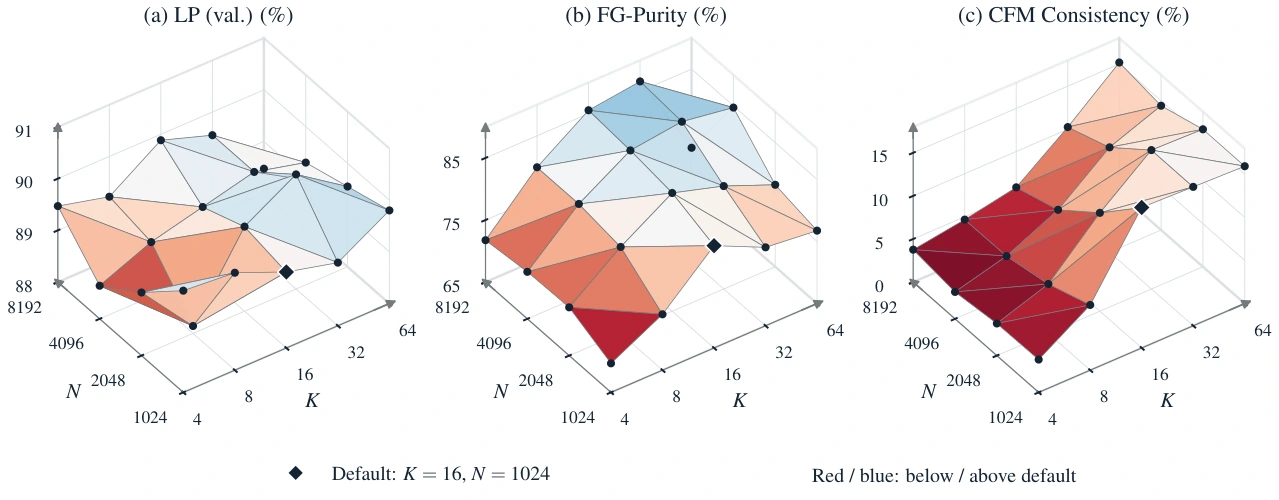
Joint bank and concept-budget sweep from the supplementary material. Each point is a measured configuration. Open the figure for the full-size view.
Why attributes and a spatial decoder matter
The attribute comparison freezes concept assignment after a bilinear-upsampled first stage, then gives each encoder the same 200-epoch continuation on PartImageNet. Differences below are against the private product-quantized reference, with 16 groups × 64 entries and 96 attribute-index bits per selected concept. They are means over three seeds. The rate excludes concept identities, geometry, and model parameters.
| Attribute pathway | Linear probe change | Image-retrieval mAP change |
|---|---|---|
| No appearance attribute | −12.24 points | −11.14 points |
| Retain continuous attributes | +0.46 points | −0.31 points |
| Share the same 16 × 64 product codebooks across concepts | −0.17 points | +0.03 points |
Appearance information is therefore consequential for retaining the backbone's representation. The shared-codebook result shows that private codebooks are not uniformly better on downstream metrics, even though they give each concept its own appearance vocabulary. In a separate continuous-stage decoder ablation, replacing the three-block spatial transformer with pooling lowers linear-probe accuracy by 1.26 points and image-retrieval mAP by 2.06 points. Six blocks roughly double decoder parameters, from 23.42 million to 44.68 million, for only +0.11 points on each downstream metric, while concept consistency falls by 2.07 points.
Full CUB part evaluation
CUB-200-2011 marks bird parts with keypoints rather than masks. Its test-set clustering metrics use cells containing visible keypoints, so mask-based mIoU and foreground ARI are undefined. The table selects representative rows from the appendix. Higher is better except for keypoint error.
| Method | Training | Foreground purity | Mapped NMI | Mapped ARI | PIP purity | Keypoint error ↓ |
|---|---|---|---|---|---|---|
| DisParQ, 16 / 1,024 | Label-free, frozen DINOv2-B/14 | 47.5 | 44.9 | 29.6 | 54.5 | 9.36 |
| ProtoQuant, stage 1 | Label-free stage, frozen DINOv2-B/14 | 44.0 | 36.4 | 24.3 | 24.6 | 11.59 |
| PIP-Net, stage 1 | Label-free stage, frozen DINOv2-B/14 | 39.7 | 32.7 | 16.4 | 37.3 | 9.87 |
| PDiscoFormer, 16 / 16 | Class-supervised, 518 × 518 input | 53.6 | 65.6 | 46.0 | 40.4 | 2.87 |
DisParQ leads the evaluated self-supervised methods on every CUB concept column. The supervised PDiscoFormer has stronger clustering and keypoint localization using a higher-resolution input and class labels. DisParQ has higher PIP purity at 16 concepts. The keypoint and map resolutions differ, as detailed in the paper's protocol.
Appearance in retrieval and concept naming
The main part-retrieval result ranks regions by concept identity. In an additional DisParQ-only test on PartImageNet, attribute codes alone find a correct first match almost as often (78.9% recall at rank 1 versus 79.7% for concept identities) but rank the full list less well (16.3 versus 30.5 mAP). Using appearance only to reorder candidates already matched by concept raises mAP to 57.3 on PartImageNet and from 9.3 to 28.1 on CUB. This is an alternative descriptor for the same model, not a comparison shared with the baselines.
The concepts are learned without text. A separate appendix experiment assigns names after training, using a frozen language-aligned teacher and a fixed vocabulary of 102,171 strings. On VOC2012 object-label retrieval, an attribute-dependent adapter raises top-1 name-to-class accuracy from 41.28% to 61.54% for the PartImageNet-trained DINOv2 model. The improvement does not carry over uniformly to PartImageNet part names: for that same model, the score changes from 23.18% to 21.74%. These are eligible-region, concept-averaged retrieval scores measured through the same text encoder used to select names. They are not an independent human judgment of name quality.
These results measure recognition, part correspondence, and human interpretation under the paper's protocols. A visually coherent concept does not by itself establish that a prediction is fair, reliable, or causally grounded. Read the methods, baselines, and metric definitions.